
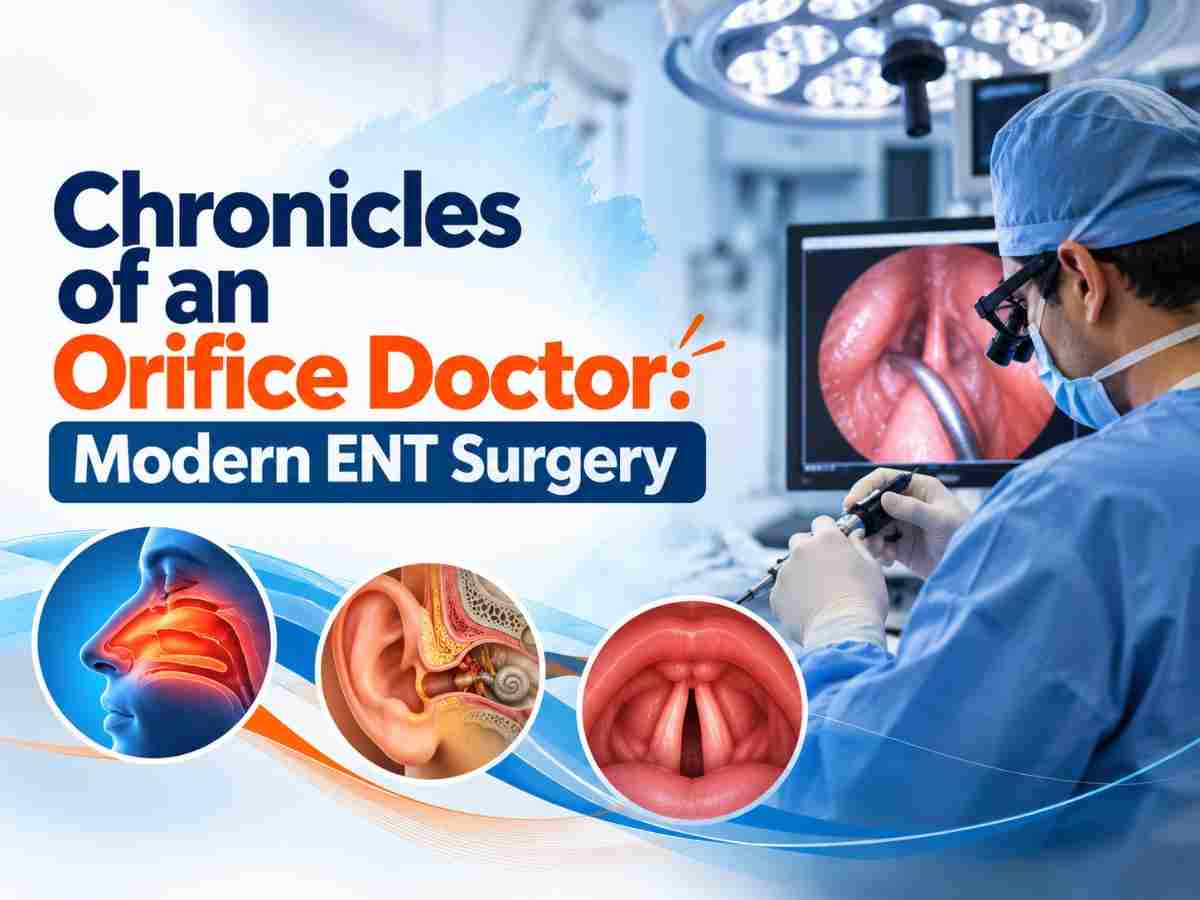
Otolaryngology sounds so fancy that most of us just go by ENTs. But let not the simplification of our specialty’s name fool you into thinking we lack sophistication. The leaps and bounds ENT surgery has made in the last decade alone represent history in the making for modern medicine. The kind of results we can deliver today stands in stark contrast to what was achievable just a couple of decades ago. With the rapid evolution of surgical precision, the future of our field is certainly worth the anticipation.
I often playfully refer to myself as an “orifice doctor” to my patients, bypassing the better-sounding title of “tri-sense doctor” for a specific reason. Given the anatomical layout and interconnected nature of our head and neck structures, symptoms in one organ are frequently the result of an underlying issue in another.
This brings me to one aspect of modern healthcare I approach with caution: online-only consultations. While convenient, remote visits often result in purely symptomatic treatment. A definitive diagnosis requires a thorough physical examination, which in our field happens endoscopically—directly through those initial orifices.
A comprehensive endoscopic exam puts all symptoms into perspective, allowing us to treat the root cause rather than just masking symptoms, often preventing the need for future surgical intervention altogether.
This message isn’t for those who get a mild viral flu once or twice a year and recover within a week. This is for those who struggle with every seasonal change—patients who have given up simple joys like sipping a cold beverage on a hot day, eating ice cream or street food with friends, or who avoid turning on the air conditioner for fear of triggering another bout of cold and cough.
We might not claim to be the most tech-obsessed clinic, but our commitment to rigorous patient follow-up allows us to catch problems early. This proactive approach helps people find lifestyle-altering solutions that minimize or eliminate the need for long-term medication. We focus on finding cost-effective, clinically appropriate solutions so patients don’t get trapped in unproven alternative therapies that have yet to supersede evidence-based medical practice.
It remains a challenge to communicate this to individuals who are hesitant to take rigorously tested modern medications, yet voluntarily consume products with unverified ingredients under the guise of natural remedies. While certain chronic or immune-related conditions do require extended care, allopathic practitioners operate on a clear principle: prescribing the minimum amount of medication necessary for the body to function optimally.
When medical management reaches its limit, surgical intervention ensures the undeterred functioning of your sense organs. The goal behind every ENT procedure is minimal intervention to restore optimal function while avoiding long-term complications. Every surgery is goal-oriented, built around precise repairs or excisions to ensure complete recovery.
In the realm of minimally invasive and scarless procedures, ENT leads the way—demanding maximum precision and extraordinary patience. Because we operate in proximity to critical neurovascular structures just millimeters away from our surgical field, our specialty requires dedicated training and meticulous execution.
Beyond clinical care, health equity remains a challenge.
Disparities in the distribution of specialist care often place a heavy financial burden on patients in urban centers. When anxious patients come to my practice, my standard reminder is that worrying about a problem with a well-established solution is futile. While that might sound like a surgeon’s confidence, it stems from deep responsibility across my core practice areas: Pediatric ENT, Otology, Lateral Skull Base, Laryngology, and head and neck procedures.
When parents entrust their child to my care, or when an adult patient chooses our clinic, I take full responsibility for guiding them. None of these decisions are made lightly. Our core philosophy is to treat every patient with care, respect, and empathy—understanding their fears and guiding them toward the safest, most effective outcome.
Otolaryngological surgeries are complex to perform, which is precisely why surgical training is so rigorous. The majority of our procedures are performed endoscopically or microscopically in tight, highly delicate anatomical spaces. Because most procedures require general anesthesia, we ensure the patient’s overall health is thoroughly optimized preoperatively.
Very few ENT cases are true acute emergencies, though those that are can be life-saving. A key focus of our practice is educating patients on the importance of addressing conditions early, preventing a straightforward, well-planned elective procedure from turning into an urgent intervention. In emergency scenarios, surgical conditions are less controlled, and outcomes become far less predictable. Ignoring a problem or adapting to a suboptimal quality of life does not make the issue disappear; it allows it to compound.
Fortunately, recovery from modern otolaryngological procedures is typically swift, with manageable postoperative discomfort. Many common procedures are performed on an outpatient or day-care basis, allowing patients to return home the same day and resume light daily activities almost immediately, achieving a full recovery within a week (GIRFT Academy, 2023). Surgical options are recommended when conservative medical therapies have reached their limits. Trusting your specialist through this process is one of the strongest factors in achieving optimal surgical results.
Unfortunately, widespread misinformation continues to deter patients from seeking timely ENT care, often rooted in outdated notions or guidance from non-operating practitioners (Catalan-Matamoros, 2025). Rather than dwelling on these frustrations, we encourage patients to choose their healthcare providers wisely and make informed decisions after thoroughly understanding the risks and benefits of all available options. We see many dedicated patients who successfully manage their conditions medically because they understand that choosing non-surgical management still requires consistent, proactive care.
References
Catalan-Matamoros, D. (2025). The hidden cost of health misinformation: distrust, treatment refusal, and delayed presentation in specialty medicine. BMC Public Health, 25(1), 102–115.
- GIRFT Academy. (2023). Expanding day case surgery in ear, nose and throat services: Best practice national delivery guide. NHS England / Getting It Right First Time (GIRFT). https://gettingitrightfirsttime.co.uk/wp-content/uploads/2023/10/Delivery-Guide-Expanding-Day-Case-Surgery-in-Ear-Nose-and-Throat-Specialty-FINAL-V3-October-2023.pdf
Ready for a smooth, comfortable recovery? Schedule a consultation with our leading ENT specialists in Gurgaon today to learn more about our advanced, minimally invasive procedures.