
Vertigo can interfere with daily activities and increase the risk of falls
Prioritize your hearing health schedule your ear checkup now.
Vertigo can interfere with daily activities and increase the risk of falls
Prioritize your hearing health schedule your ear checkup now.
Consultation
Vertigo complaints ENT
Common Causes of Vertigo:
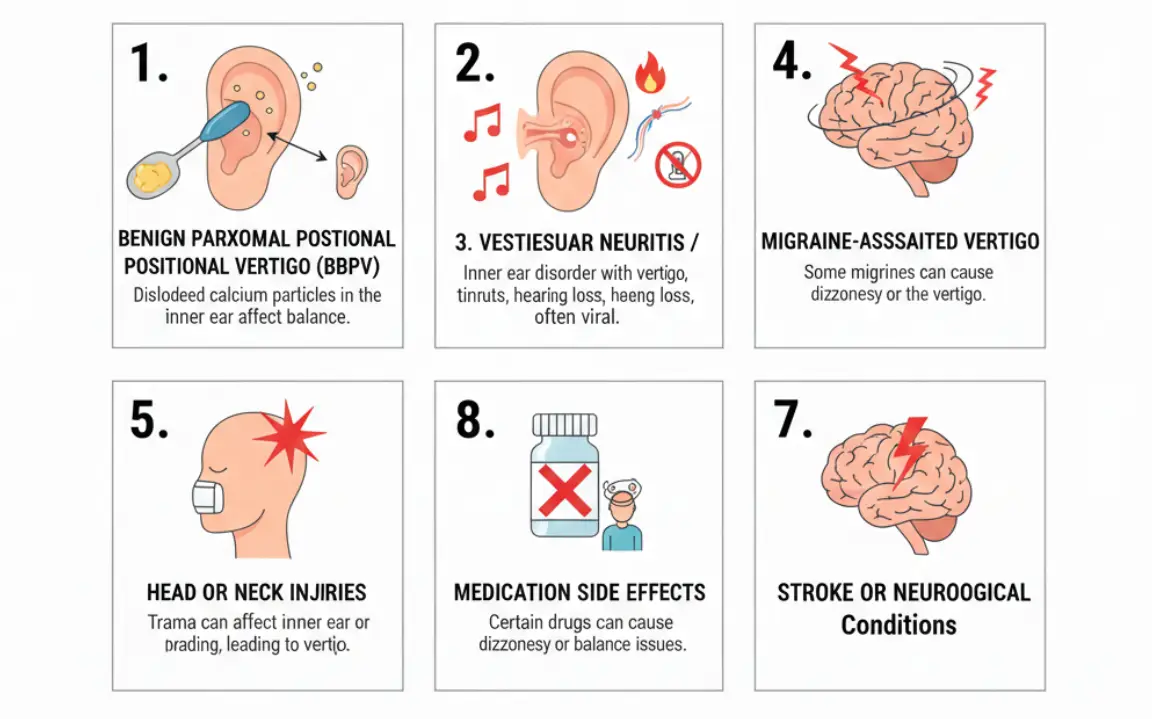
- Benign Paroxysmal Positional Vertigo (BPPV) – Small calcium particles in the inner ear get dislodged and affect balance.
- Meniere’s Disease – A disorder of the inner ear that causes episodes of vertigo, tinnitus (ringing in the ears), hearing loss, and a feeling of fullness in the ear.
- Vestibular Neuritis or Labyrinthitis – Inflammation of the inner ear or its nerves, usually due to viral infections.
- Migraine-associated Vertigo – Some migraines can cause dizziness or vertigo.
- Head or Neck Injuries – Trauma to the head or neck can affect the inner ear or brain, leading to vertigo.
- Medication Side Effects – Certain drugs can cause dizziness or balance issues.
- Stroke or Neurological Conditions – In rare cases, vertigo may be caused by serious conditions like a stroke or multiple sclerosis.
Key Components of a Vestibular Assessment:
1. Patient History & Symptom Evaluation– Duration & frequency of vertigo episodes, triggers, associated symptoms ( nausea/vomiting, headache, hearing loss or tinnitius), past medical history.
2. Physical Examination
- Neurological exam – Checks for signs of nerve dysfunction.
- Gait & balance tests – Assess standing and walking stability.
- Romberg test – The patient stands with feet together, eyes closed, to check for balance.
3. Vestibular Function Tests
These tests assess how the inner ear, brain, and eyes work together for balance.
A. Dix-Hallpike Maneuver (For BPPV)
The patient is quickly moved from a seated to a lying-down position with their head turned.
Positive sign: Vertigo and nystagmus (rapid, involuntary eye movements), indicating BPPV.
B. Videonystagmography (VNG)
Measures eye movements using infrared goggles.
Helps detect nystagmus, which can indicate inner ear dysfunction.
C. Vestibular Evoked Myogenic Potential (VEMP)
Evaluates how the saccule (inner ear) and vestibular nerve respond to sound.
Helps diagnose Meniere’s disease and vestibular neuritis.
D. Rotary Chair Test
The patient sits in a motorized chair that rotates slowly.
Measures how the eyes and brain react to movement.
Useful for detecting bilateral vestibular loss.
E. Posturography
The patient stands on a moving platform.
Evaluates balance control and sensory integration.
F. Caloric Testing
Warm and cold water or air is introduced into the ear.
Tests the vestibulo-ocular reflex (VOR) to see if both ears respond equally.
Helps diagnose unilateral vestibular dysfunction.
4. Additional Tests
Hearing tests (Audiometry) – To check for hearing loss (Meniere’s disease).
MRI or CT Scan – If a central cause (brain tumor, stroke) is suspected.
Blood tests – To rule out metabolic causes (diabetes, vitamin deficiencies).
Treatment Options:
- Epley Maneuver (for BPPV) – A series of head movements to reposition ear crystals.
- Vestibular Rehabilitation Therapy (VRT) – Exercises to improve balance.
- Medications – Such as antihistamines, anti-nausea drugs, or steroids, depending on the cause.
- Lifestyle Changes – Reducing caffeine, salt, and stress for conditions like Meniere’s disease.
Our Recent Blogs
Monsoons are very heartily welcomed and always have brought joy, abundance of life and vegetation but alongside comes illness and

Not everyone will visit an ENT in their lifetime, they never might have been affected or they are blissfully unaware

Children are very resilient. From the age of 6 months to 2 years, a child has a developing immune system

It is the most commonly self diagnosed and self treated condition. It is estimated that one in every 8th person
Snoring is the resultant sound that occurs when two relaxed surfaces collapse into each other during a sleep cycle. Snoring

Have you experienced that nagging or intense pain during take off which settled down over the course of flight only